

This is a Research-Prayer that follows the threads of Eco-Mythology and Eco-Feminism. The goal is to reinterpret, subvert, and turn around Eurocentric feminine constellations myths from other perspectives—decolonial, ecological and interconnected. Other questions and possibilities, revelations and redemptions, implications and consequences might emerge, because the past was never just one thing, and the future can be so many others.
In times of violent and systematic attacks on the most basic rights and dignities of bodies and ecologies, I offer these eco-mythic and eco-feminist writings as a polyphony to counter the monoculture of thought and sensing that impoverishes us all. The voices that carry this body of work are the Feminis Bestialis (*), those of deep memories and of the sovereign, insubordinate body.
YOU ARE HERE - Part I
Oct. 6, Part II
The offense is not “vanity,” but the rupture of the relationship;
Cassiopeia and the convenient category of the “vain woman”;
The punishment does not end: the female body as a spectacle of humiliation;
Andromeda is the body of ecological debt;
The difference between being vulnerable and being made expendable;
Andromeda as a figure of the periphery.
Oct. 13 Part III
Perseus’s Heroic Solution;
Perseus restores a certain order of gender and property;
The hero saves a woman with the severed head of another;
Pegasus: who sustains the hero’s flight?
Hippe: the horse-woman hidden within the constellation.
Oct. 20 Part IV
Cetus Is Not the Villain;
Before Becoming Cetus;
The Sea Where Cetus Can Barely Make Himself Heard;
What Culture Chained Her There?
⁂
To honor the many hours of study, research, and critical reinterpretation, these articles are paid content.
If you’d like to learn more and dive into this fertile dissent, please consider supporting this work with your subscription.
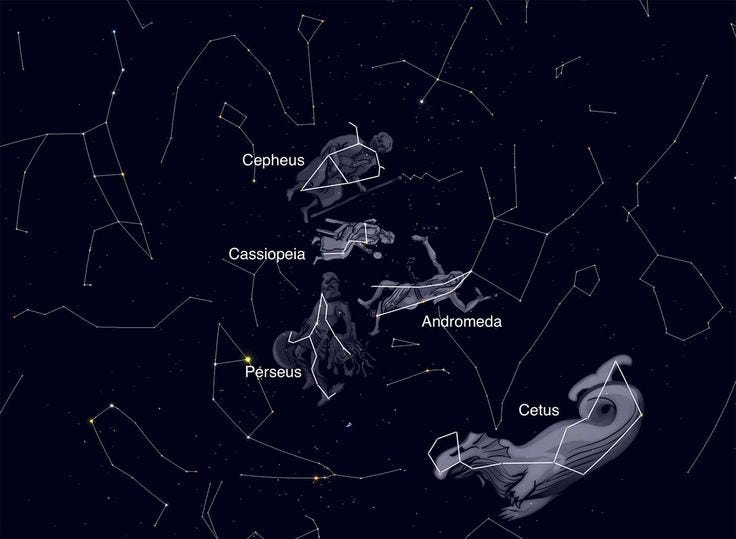
We’ll start with Andromeda, from myth to constellation.
Constellations have been grouped and mapped throughout human history; some, such as the Pleiades or the Big Dipper, date back about 100,000 years. When Greek civilization emerged, many of the modern Western constellations (yes, because there are so many other ways to map the sky) had already been grouped over generations into myths, navigational systems, and calendars.
We begin with Andromeda, from myth to constellation. Although popularized by classical Greece, the origin of this myth seems to date back to much older influences in Mesopotamia. Research suggests that the legend of Andromeda and the sea monster has its roots in the ancient Babylonian Creation Epic, corresponding to the battle of the god Bel Mardūk against the dragon Tiamat, the great grandmother of the world.
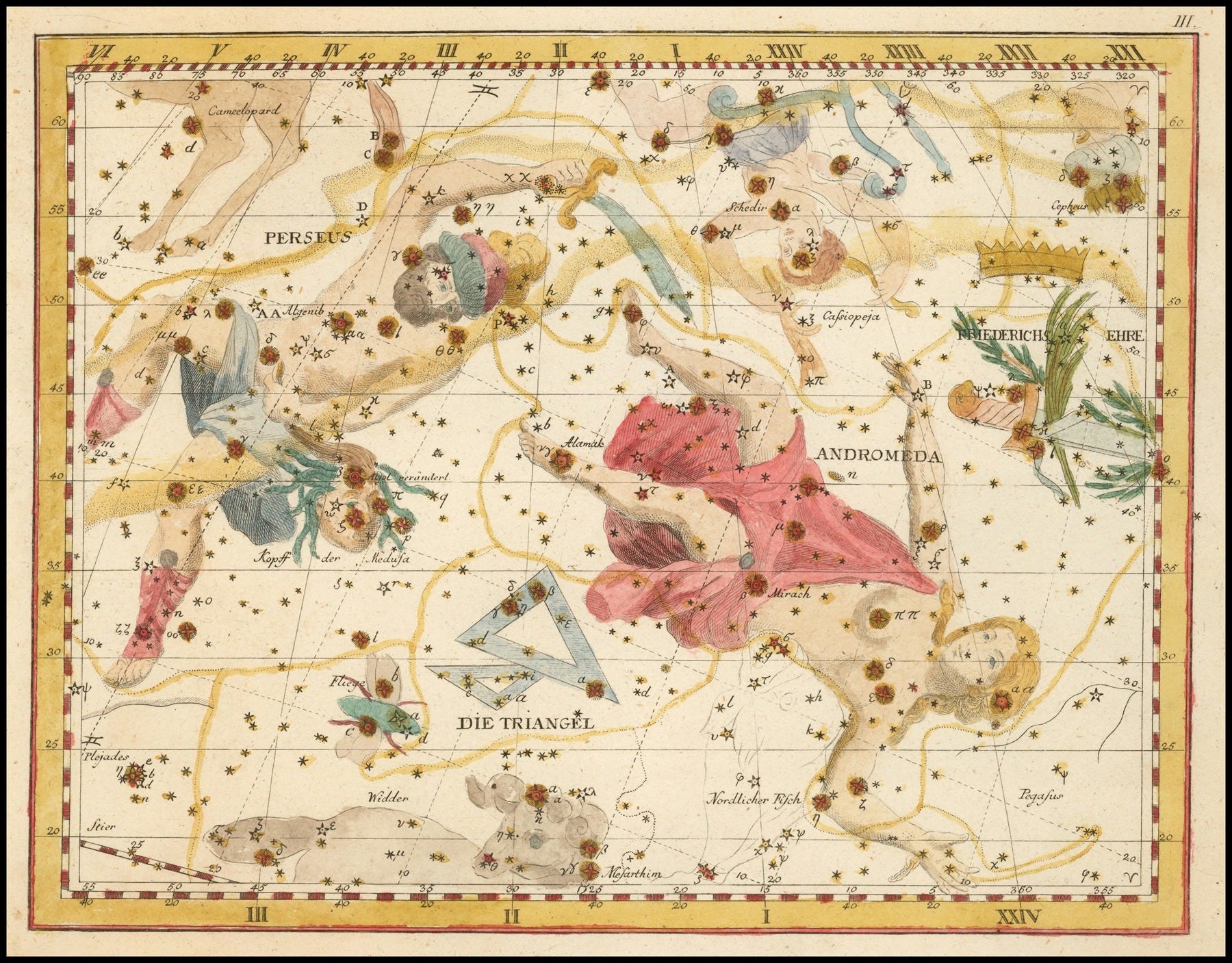
Andromeda is part of a group of constellations that tell her myth: Cassiopeia (mother and queen of Jope or Aithiópia), Cepheus (father and king of Aithiópia), Perseus (the hero who saves her), Cetus or kētos (the sea monster sent by Poseidon), and, of course, Andromeda herself. The tradition of catasterism weaves Andromeda into the stars, preserving her outstretched and chained body.
✦ The Myth of Andromeda
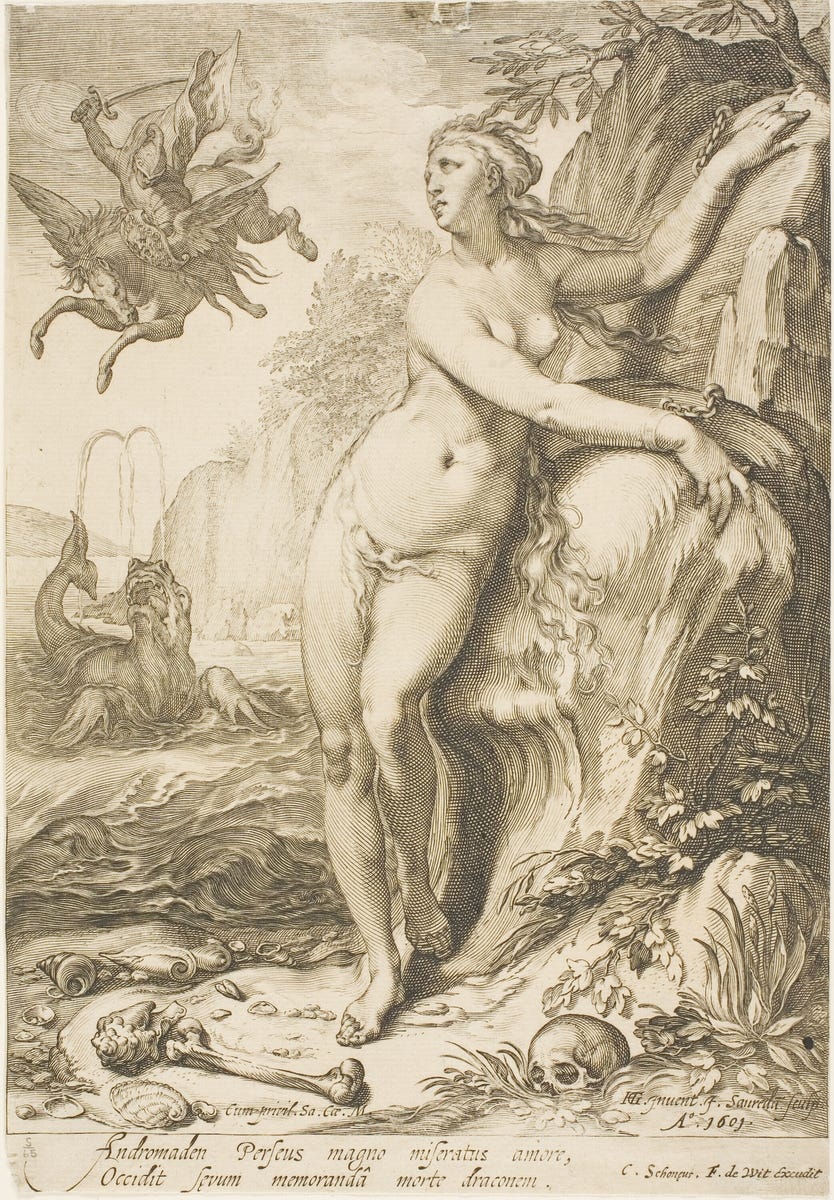
In the best-known version of the myth, Queen Cassiopeia (married to King Cepheus, rulers of Aithiopia) proclaims her daughter, Andromeda, to be more beautiful than the Nereids. Poseidon, the god of the seas and father of the Nereids, is offended that a mortal would dare to claim that his daughter is more beautiful than his own daughters. Poseidon responds to the insult by flooding the coast and sending the kētos, the sea monster. To restore order, an oracle demands that the mortal Andromeda be exposed to the monster, chained to a rock by the sea. Andromeda is then stripped naked and chained to jagged rocks by the raging ocean, awaiting her tragic end.
While the terrified princess waits for the creature, the hero Perseus passes by. He was returning from his dangerous mission to behead the Gorgon Medusa and was carrying the monster’s head with him. Upon seeing Andromeda chained and weeping, Perseus fell in love with her instantly. When Cetus emerged from the ocean to devour her, Perseus waged a fierce battle with the monster, defeating it with his sword or petrifying it by exposing the creature to the gaze of Medusa’s head.
As a reward for his bravery, Perseus demanded Andromeda’s hand in marriage. Although the young woman’s parents strongly opposed her union with a foreigner, Andromeda—distrusting the judgment of those who had sacrificed her to save themselves—decided to follow Perseus. Abandoning her family and homeland of her own free will, she traveled with the hero to the city of Argos. Together, they lived for many years and had several children (six, according to some accounts). Their eldest son, Perses, became the ancestor of the Persians, and other children became founders of Mycenaean dynasties, including Electryon, grandfather of the legendary Heracles.
To commemorate Perseus’s deeds and keep the family united for eternity, the gods (at the behest of Athena or Zeus) placed them among the stars. Andromeda was depicted in the sky as the “Chained Woman” (Mulier Catenata), with her arms eternally outstretched in a gesture of suffering. Near her shine Perseus, Cepheus, Cetus, and her mother, Cassiopeia. As an eternal punishment for her vanity and impiety, Cassiopeia was placed in a position where she travels upside down for half of the celestial rotation, plunging humiliatingly into the sea.
✦ Rereading, Subverting, and Revolutionizing the Myth
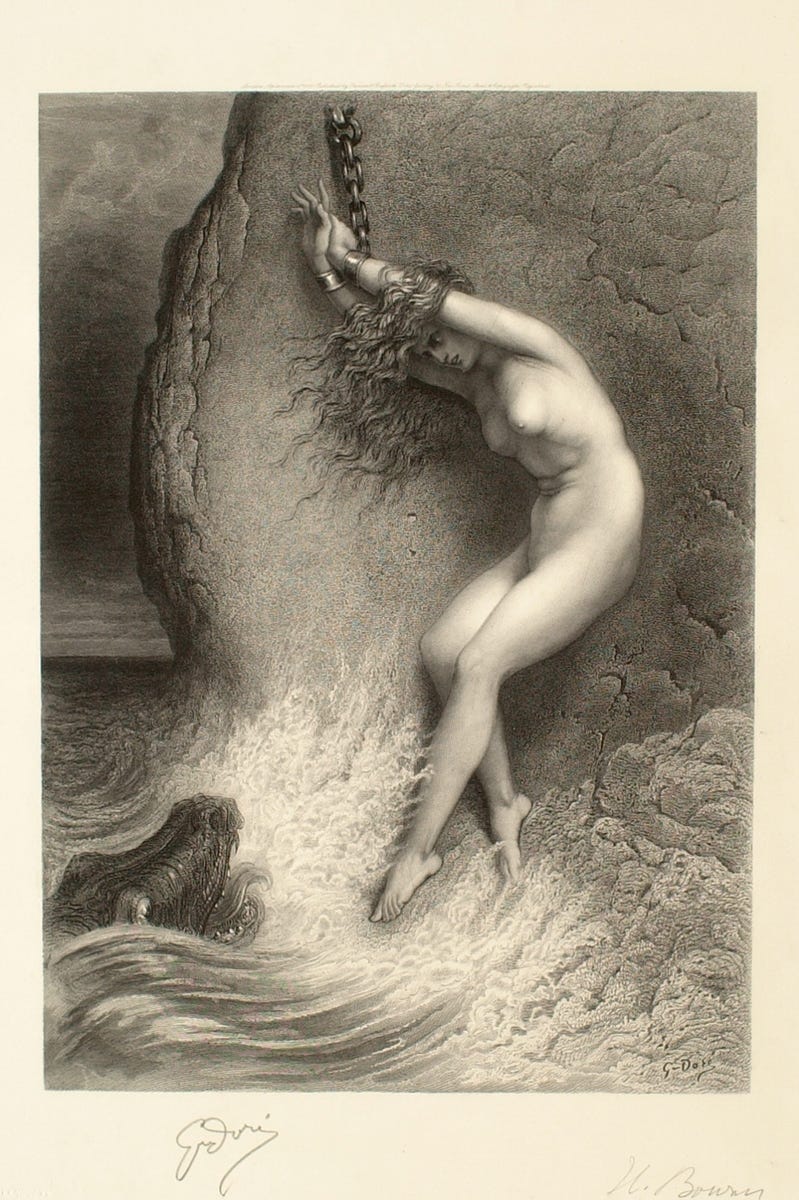
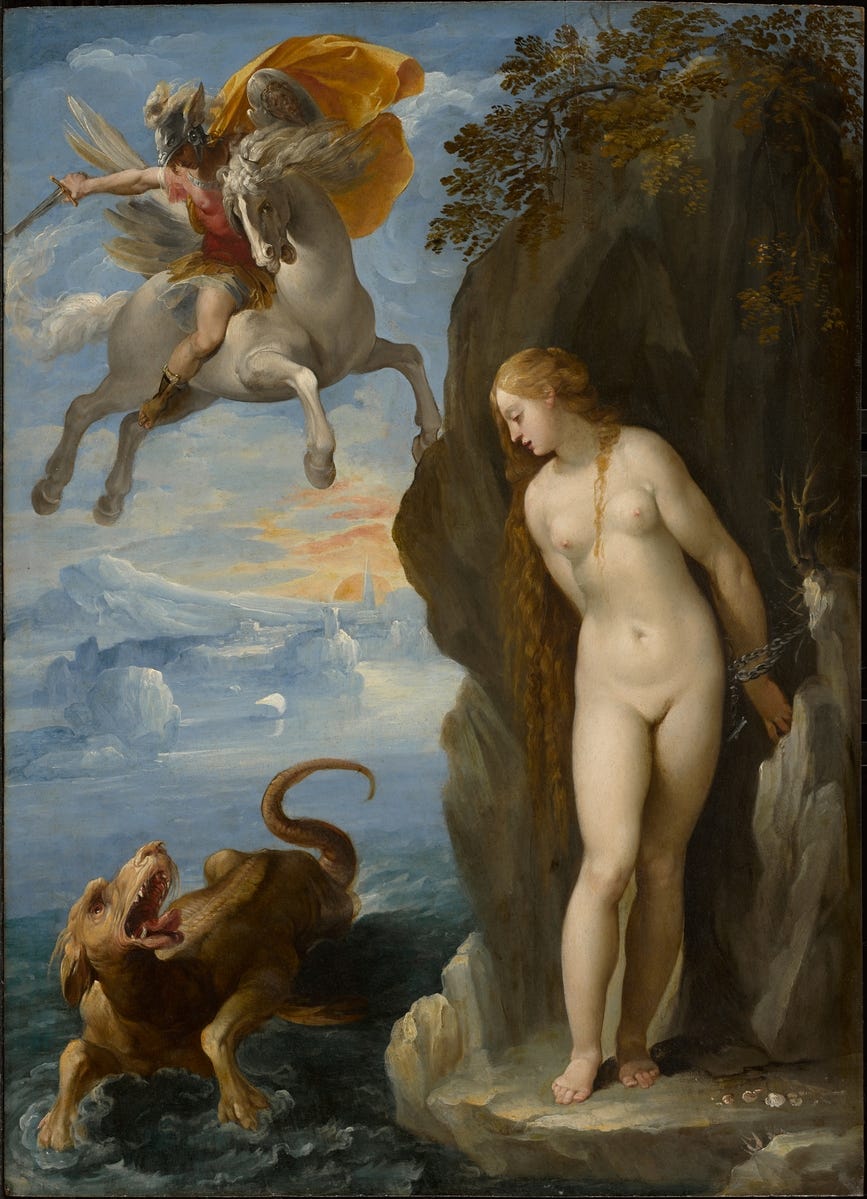
The myth of Andromeda has many layers and holds the potential for untamed, eco-mythical, and ecofeminist revelations. At the very least, I want to challenge the normative structure of “damsel in distress + hero savior”. The Feminis Bestialis remind us that the myth can be read as a rupture of reciprocity between the human community, the sea, and the non-human, in which the human solution is the sacrifice of the female body, violence, and male heroism.
But the Feminis Bestialis won’t forgive me if I don’t state, right from the start, that gender is not a minor detail in this myth (just as in so many others… anyway). They roar that beyond the anthropocentric axis (ecological rupture, sacrifice, heroic solution, which we explore below), the ecofeminist lens asks: why is the rupture between human sovereignty and the sea inscribed precisely on the body of a young woman? This is certainly not a detail, but rather a fundamental structure of the patriarchal myth.
We reveal Andromeda, Cetus, and Perseus as three responses to the crisis: sacrifice, the monster’s attack, and the salvation of order. This leaves out the possibility of reciprocity as a response—this absence is an insidious and invisible cultural pattern.
Andromeda’s sacrificial body intertwines gender, power, territory, and the non-human in the myth. However, I do not wish to turn Andromeda into a universal allegory of “Mother Earth”; I do not wish to perpetuate one of the associations that European ecofeminism needs to destabilize. I do not wish to turn either women or nature into undifferentiated universal victims.

)
