
Black Dog
{on growling and cynicism}

» (Un)Learning Eco-Mythic Trails
» Eco-Therapeutic Counselling—Conversations through the Art of Listening and Silence
We have many megalithic ruins, some of which are still painted or carved. In our folk tales, there is an ancient being called “Mouras”—ancient telluric and chthonic forces (powerful and sacred primal energies generated by the land)—that guard special places. They appear during the solstices and equinoxes, or at midnight. They are usually women who transform into snakes for the most part, but also into large black dogs (…).” (from here)
*
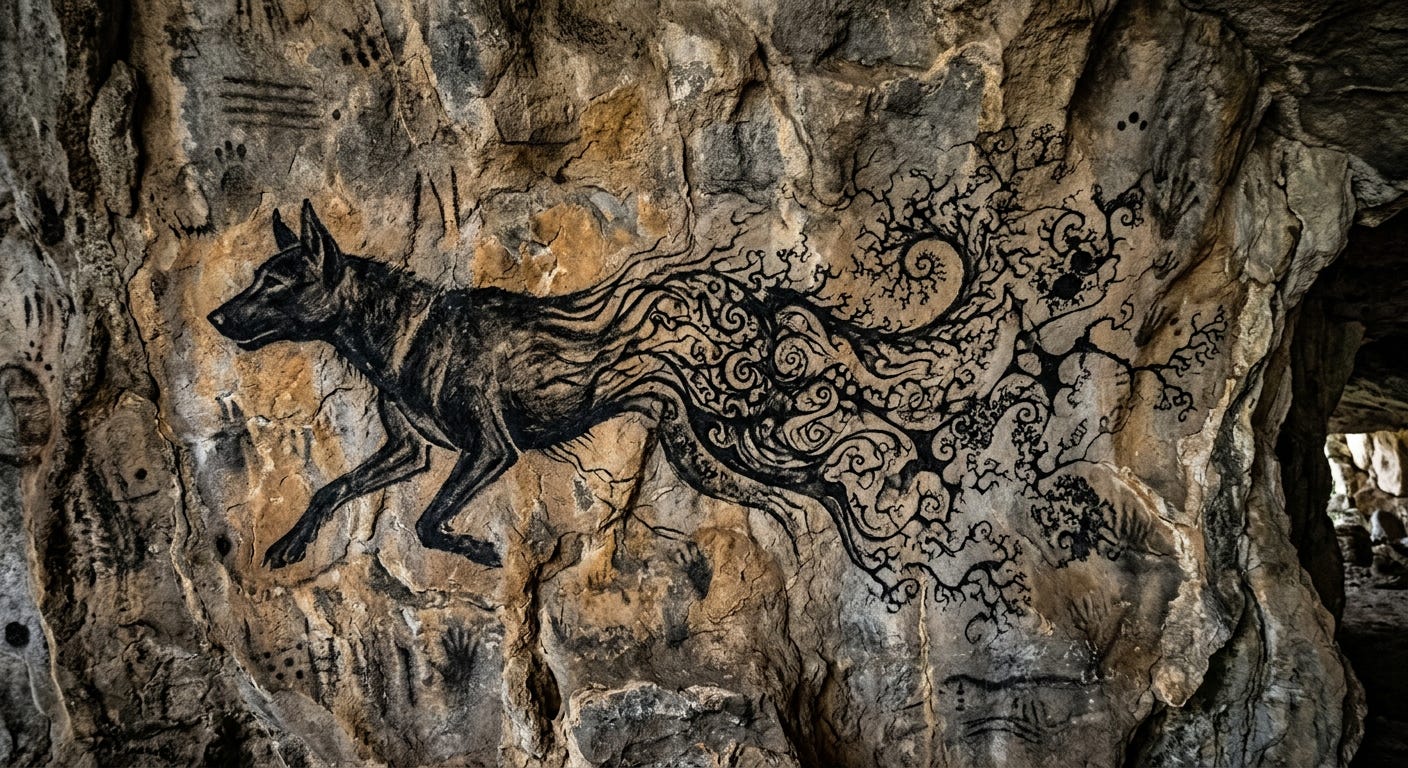
The Black Dog watches me from the shadow of the threshold. Her body dissolves with every hair, recomposing herself with every blink of an eye. She growls softly as she transforms, a fractal body always changing. Unforms and reforms. She howls; perhaps she is alone. I feel her damp breath, too close, too hot. As saliva drips from its sharp fangs and her claws scrape against the dry earth. My heart tightens, not with sadness, but with deep rage. It tears me apart where I cannot express myself. Perhaps she has always been here, the Black Dog with golden eyes and a fractal body, as ancient as time, as present as ash and rock. I don’t know if she wants to eat me or give me her paw, if she wants to curl up in exhaustion or run with me out of here. If she guides me or imprisons me. Perhaps she doesn’t know either.
*
Some time ago, I described myself in Substack’s short biography as “(…) curious, on the spectrum of cynicism”. Today I was struck by this growl that makes the hairs on the back of my neck stand on end. I return to the word cynicism, which comes from the Greek kynismos, from kyon/kynos, meaning ‘dog’ (from the PIE root *kwon).
The Cynic philosophers were literally called “those who live like dogs,” which, at first, was not an insult. The Cynic philosophers lived without social masks, rejecting hypocritical conventions and exposing the falseness of power. Those who lived like dogs, such as Diogenes of Sinope, lived on the streets; they were direct, physical, and even “indecent.” They criticized the authorities and did things considered “shameful” in public, precisely to show that social shame was a construct. Diogenes studied philosophy with Antisthenes, a rough-and-tumble fellow who taught at a gymnasium called “The Silver Dog,” in the ancient Garden District on the outskirts of Athens. It was open to foreigners and the lower classes—and thus to Diogenes. The sharp-witted minds of the time played on its name, calling its members stray dogs, hence the term cynic. [Guy Davenport, “Seven Greeks”]
Perhaps the dog has already been captured here, growling at an order that needed him as an escape.
*
Recently, the UN declared slavery the most heinous crime against humanity. Europe abstained. The claws scrape against the dry earth. Knowing that this vote does not change material conditions, the original body of cynicism enacts what I feel toward Portugal (and Europe): shame, the refusal of historical cleansing, and discomfort with polished narratives.
The structural lie is impossible to unsee. The systematic refusal to let the body of history contaminate national identity. Because nothing can disrupt the pride of a history built on brave, spotless heroes.
The Black Dog, with golden eyes, as ancient as time itself, refuses to accept the sterilization of history, as if it were fragments rather than a structural foundation. Her fractal black fur bristles at the “historical pride” of the “discoveries” and “expansion,” brought forth to prevent the narrative from collapsing. I feel in my body the quivering of her metamorphic skin, her muscles taut and ready to attack in the face of the disconnect between reality and massive, structural violence—of how it is kept “clean,” narratable, and acceptable. Of bodies forcibly extracted, amputated and punished, exiled and silenced, in omnicides still unfolding. I pay the price, I retreat to the corner, I isolate myself. I cannot enter the national discourse without feeling friction. I pay the cost of belonging for non-collaboration with oblivion or blindness.
Beyond the shadow of the threshold lies the Black Dog, who refuses anesthesia, but I cannot reach her. Perhaps I do not want to either, for I already feel her teeth piercing my hand. It hurts. A lot. After all, anesthesia is still necessary in this body of mine, despite the frustration of not being able to transform it entirely or find a collective space for such a thing.
*
Crouching here in the corner, I find myself thinking about how modern cynicism makes coloniality possible. Yes, I am inverting what is considered a symptom into a cause, for, after all, it is a fractal ‘loop.’ Doing and undoing, shaping and unshaping. Colonization may be a product of a pre-existing cynical worldview. After all, modern cynicism may be the cosmology that allowed for the creation of this violent system, the psychological condition that makes coloniality thinkable, acceptable, and reproducible. Because it is not just a hubristic attitude of “nothing matters,” but a structure that universalizes the human as inherently selfish, assuming that only self-interest drives everything. This structure discredits the possibility of genuine relationships and desacralizes life. The world ceases to be a relationship and becomes an object and resource. And this facilitates exploitation, hierarchy, domination, and colonization. Modern cynicism dismisses the entanglement of life as a romantic fantasy.
This is an ontological cynicism about life, humans, and the world, which generates colonial systems of hierarchy and exploitation. In turn, these systems produce more cynicism, disillusionment, and apathy. Cynicism reinforces the system, for no one believes it can change.
By describing myself as on the “spectrum of cynicism,” with the Black Dog growling on the other side of the threshold, I position myself as a daughter of coloniality. I know the system is unjust, but I continue to operate within it. I see it, but I remain crouched in the corner.
I am afraid, for, after all, I need to rebuild the bond—not with a redemptive idea of the world that keeps me at the center, but with a metamorphic world that bites. As alive and sacred as it is monstrous. The colonial institutionalization of cynicism, in structures within and outside of us, weighs on our bodies. We know the system is violent, but we remain within it. Not necessarily just out of convenience, but also out of the fatigue of seeing the contradictions and the frustration that nothing changes. Through the narrowing erosion of imagination itself. In my white colonial context, where nothing is called into question, the body, weary, shuts down due to a lack of resonance.
This weariness is not the same as “colonial cynicism.” If colonial cynicism says: “nothing has value, I can exploit.” Fatigue says: “everything has weight and I can no longer bear to carry so much.” If the former brings desacralization and kills worlds, the latter comes from the overload of feeling/seeing and the silences of amputated voices. Right here, from the corner, I see her saliva dripping from her teeth, while she pierces me with her golden gaze. Of course, I’m stuck in the same loop: I see, I tire, I step back, and the system continues. In fact, as the Black Dog reminds me, the system doesn’t need us to believe in it; it just needs to keep us too tired to confront it, time and again. The exhaustion of having waited for a change that never came, or of having invested energy with no return. The exhaustion of debates without listening, based on the best performance, “being right” as social currency. I stay here in the corner, not out of indifference, but out of refusal to participate in an empty form. From here, I see that the house is empty and in ruins, walls bare from a lack of listening, floors cemented against real curiosity, doors closed to otherness.
Perhaps I isolate myself here not only to escape, but because I don’t know how to continue in a relationship without falling into the logic of dispute and exhaustion. And the system continues to win, for it disconnects me, tires me of the impoverished ways of thinking together.
This is the cynicism of collapse, the rupture between the virtual and the visceral. It is as if there were no longer enough distance to sustain illusion and no longer enough body to metabolize what is coming. The body short-circuits from the feeling that everything is connected and that everything matters, and from the inability to act in accordance with that awareness. How to inhabit this collapse without hardening or disconnecting?
Modern cynicism becomes elegant, acceptable, even “mature” when, in truth, it is a sophisticated way of avoiding the wounds. Cynicism is almost a strategy for resolving dissonance; it doesn’t truly resolve it, but it alleviates the discomfort. It is institutional cynicism, which distances itself as a neutral, ironic observer, protecting the narrative of hegemonic power. It maintains the illusion of normality. From here in the corner, I feel the Black Dog, with her fractal body, placing a paw inside the threshold. My body shudders, for her golden gaze sees through the illusions. After all, kynismos is an untamed, visceral, and unfiltered body, while modern-colonial cynicism is virtual, found in discourses of management, image protection, and abstraction.
*
But “cynicism” is not merely a modern accident, for it is ingrained in traditional tales as a means of survival. For if the world is harsh and justice is not guaranteed, we “naturally must lie, deceive, and bend the rules.” Cunning and opportunism appear natural and inevitable. If in ancient tales, cynicism was a response to a harsh world, now cynicism is part of the very structure that keeps the world harsh. As if it were inevitable.
There are several “masks” of cynicism, and all appear in the tales: brutal cynicism (survival)—the world is unfair, so I play the game; dissociative cynicism (avoiding pain)—nothing affects me, so I don’t get involved; ideological cynicism (spiritual neoliberalism), everything is mindset, erasing structure; satirical cynicism (exposing power), as seen in Basile, who ridicules authority. In the Eurocentric and structurally racist tradition of the tales, Lucia (the Black slave in *The Three Citrons of Love*) uses a lucid and cynical ruse to usurp the heroine’s place. When confronted by the prince about the change in her appearance (from white to black), she coldly replies that she is enchanted: “one year white face, one year black tail.” It is nonetheless cynical that coloniality projects cynicism onto those from whom previously stripped of all dignity.
*
Here, from inside the threshold, I still hear the Black Dog—perhaps once Moura—growling from the shadows, guarding the deep, visceral memory of other forms of dignity. I, too, begin to growl, restless, caught between denunciation and legitimization. The (colonial-cynical) system prevents dissonance from becoming a dilemma by offering hubristic, quick answers, producing ready-made discourses, and creating empty debates that keep the wound at a distance and sutured. It keeps everything at the level of dissonance, without ever acknowledging the actual collapse. What we feel as cynicism may, in fact, be the weariness of sustaining a dilemma in a world that insists on resolving it superficially.
The Black Dog guarding the threshold whispers: “there are multiple overlapping realities.” My wound is open, for perhaps the Black Dog has already bitten me. The wound oozes with paradox and rawness. It is as much mourning as it is a loss of narrative and belonging. I feel her damp breath, too close, too hot.
References:
https://www.blogs.unicamp.br/mulheresnafilosofia/hiparquia-de-maroneia-2/
Allen, Ansgar. Cynicism. Cambridge, MA: MIT Press, 2020
Bewes, Timothy. Cynicism and Postmodernity. Londres: Verso, 1997
Cox, Meg E., org. Cynicism and Hope: Reclaiming Discipleship in a Postdemocratic Society. Eugene, OR: Cascade Books, 2009