
El Niño
And the Cataclysm of Voracity

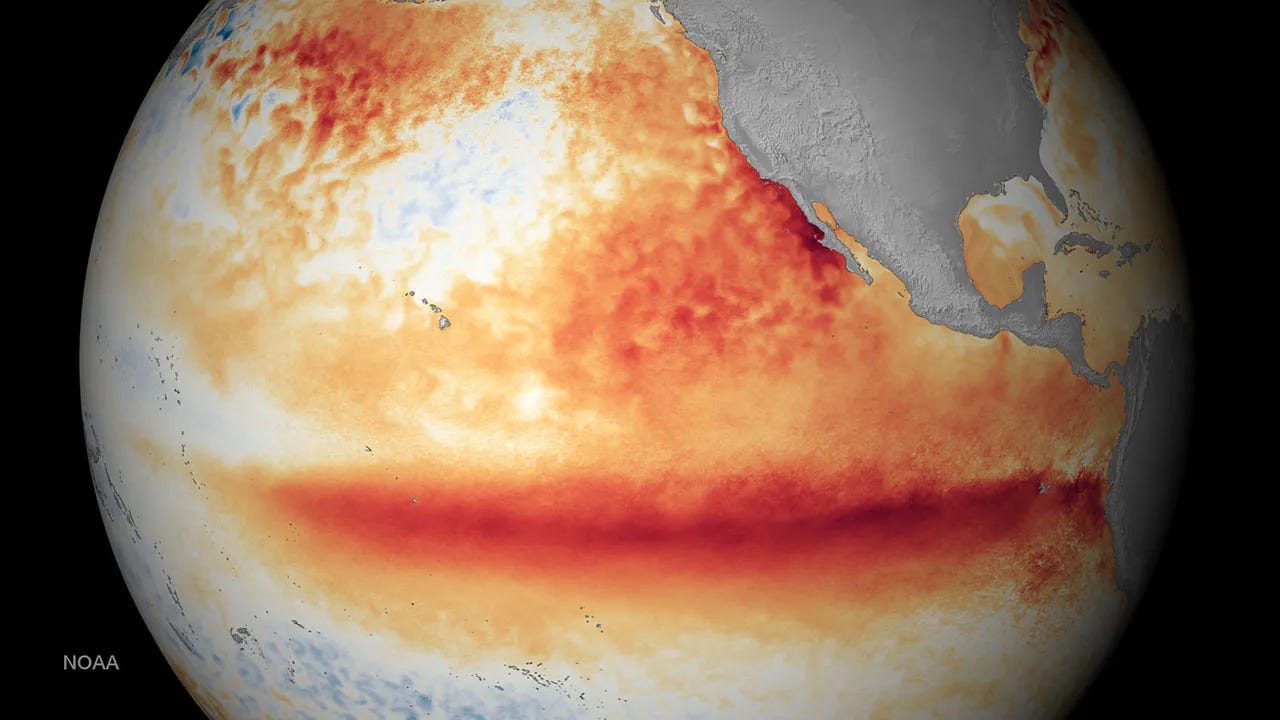
A storm is brewing, “El Niño”.
I want to view it as a disturbing metaphor—the boy or the child. I swear I really didn’t want to write this article at all.
“El Niño” is the name given to an ocean current that is now out of balance, a climate cycle that alters rainfall, droughts, harvests, fires, and storms on a global scale. Today, the disruption of the major currents that help regulate the Earth’s breathing.
The World Meteorological Organization has stated that this El Niño is expected to intensify throughout the remainder of 2026, causing more extreme weather conditions across much of the globe. Several forecasts from national meteorological agencies suggest it could become one of the strongest on record—a possible “super” El Niño. (from here)
There is an irony in the name El Niño, for, before it was a global climatological category, it was a name given by fishermen in northern Peru to the warm current that arrived in December, at Christmas time: the Child, the Baby Jesus, the divine child. But when this name passes through modern, Christian, and detached grammar, something shifts. The child ceases to be a local relationship with the sea, food, cycles, fishing, survival, and now names a planetary anomaly. The Child becomes a sign of deregulation. And this association is a brutal image of modernity itself, of this pseudo-adult culture that, having lost the capacity to care for its children and its mother currents, links childhood to catastrophe, threat, excess, and disruption. Not because the child is so, but because the world that receives it has become incapable of reciprocity.
The child as cataclysm
Industrial modernity has domesticated childhood. It has isolated the child from the community, separated them from the territory, confined kids to specialized institutions, and transformed development into a matter of individual performance.
Childhood has become simultaneously overprotected and profoundly abandoned. And the child now returns tempestuous, demanding the tenderness that is owed to them.
Protected from immediate risks but abandoned to the erosion of the bonds that sustain relational and ecological maturity. Instead of learning that they belong to a living world, they often learn that they inhabit a world composed of resources, services, and objects. Their task becomes to compete, stand out, and adapt to the existing system. Children do not inherit a community or territory, but a curriculum and a market. Much criticism from indigenous and decolonial psychology points precisely to this individualization of suffering and the loss of the relational contexts that produce well-being and identity.
When a culture ceases to know how to welcome and embrace its children, it ends up producing displaced and gigantic forms of childishness within its institutions. Deregulations that include limitless desires, unrestrained impulses, hunger without reciprocity, and of course extraction without maturity. But all legal.
The child is not an individual project under construction—this is what many indigenous, communal, and relational cosmologies remind us. It is a collective event, for children belong to the village, the river, the trees, the ancestors, and those not yet born. The child is not seen as an empty vessel to be filled, but as a presence already in relationship with a living world. Their growth is not a race toward autonomy, but a gradual learning of interconnection and reciprocity. Darcia Narvaez describes how many indigenous societies sustain childhood through extensive networks of care, physical contact, emotional responsiveness, and community participation, viewing the child as part of a kinship web extending beyond the nuclear family.
On the other hand, many indigenous traditions describe modernity not as a mature, adult civilization but as adolescent or infantilized—incapable of recognizing limits, accepting reciprocity, and understanding long-term consequences. Inherently irresponsible. A culture that wants everything immediately, that transforms desire into a right and growth into an inevitable destiny.
The return of what was forgotten
In this sense, El Niño can be read as the return of what was forgotten. The planet’s currents now make visible what cultural tides have been doing for centuries: disrupting and disturbing cycles. As if the Earth were mirroring, in atmospheric and oceanic language, what modern culture has been practicing in historical and social language. With devastating impacts for all.
We can also note that in many relational cultures, maturity is not measured by independence, but by the ability to care for the relationships that sustain us. Thus, becoming an adult means becoming a guardian of the world.
In modernity, on the contrary, maturity has often become synonymous with separation, control, and autonomy. I think this is why our children today carry such a particular pain, not only because they will inherit the consequences of systematic omnicides… but because they have been robbed of the experience of belonging to a world alive enough to teach responsibility without terror and reciprocity without guilt.
This extreme El Niño leads me to questions that are not merely meteorological but civilizational.
What happens when an entire culture remains trapped in a ravenous infantilization?
And what would it take for us to grow again, not in power, consumption, or expansion, but in the capacity for responsible kinship?
Before concluding, I want to clarify that this reflection lies in the realm of metaphor, not denial. I present El Niño as a consequence of a way of inhabiting the world, a cultural metaphor, yet without diminishing the gravity of its consequences, such as droughts, fires, floods, crop losses, forced displacement, mortality, and profound disruptions to already fragile ecosystems. Human and non-human lives, species, rivers, forests, reefs, crops, and entire communities are exposed to destruction. The metaphor of an abandoned childhood that becomes a voracious planetary monster—the cataclysmic child—asks what we can (un)learn when currents, climate, and culture intersect.
References:
https://www.britannica.com/science/El-Nino
https://www.bbc.co.uk/news/resources/idt-54f4e985-a7fb-48b2-8246-f3be0d699402
Restoring the Kinship Worldview: Indigenous Voices Introduce 28 Precepts for Rebalancing Life on Planet Earth.