
Intersectional Myth
If myth is a relational living meshwork, then it cannot help but be intersectional.

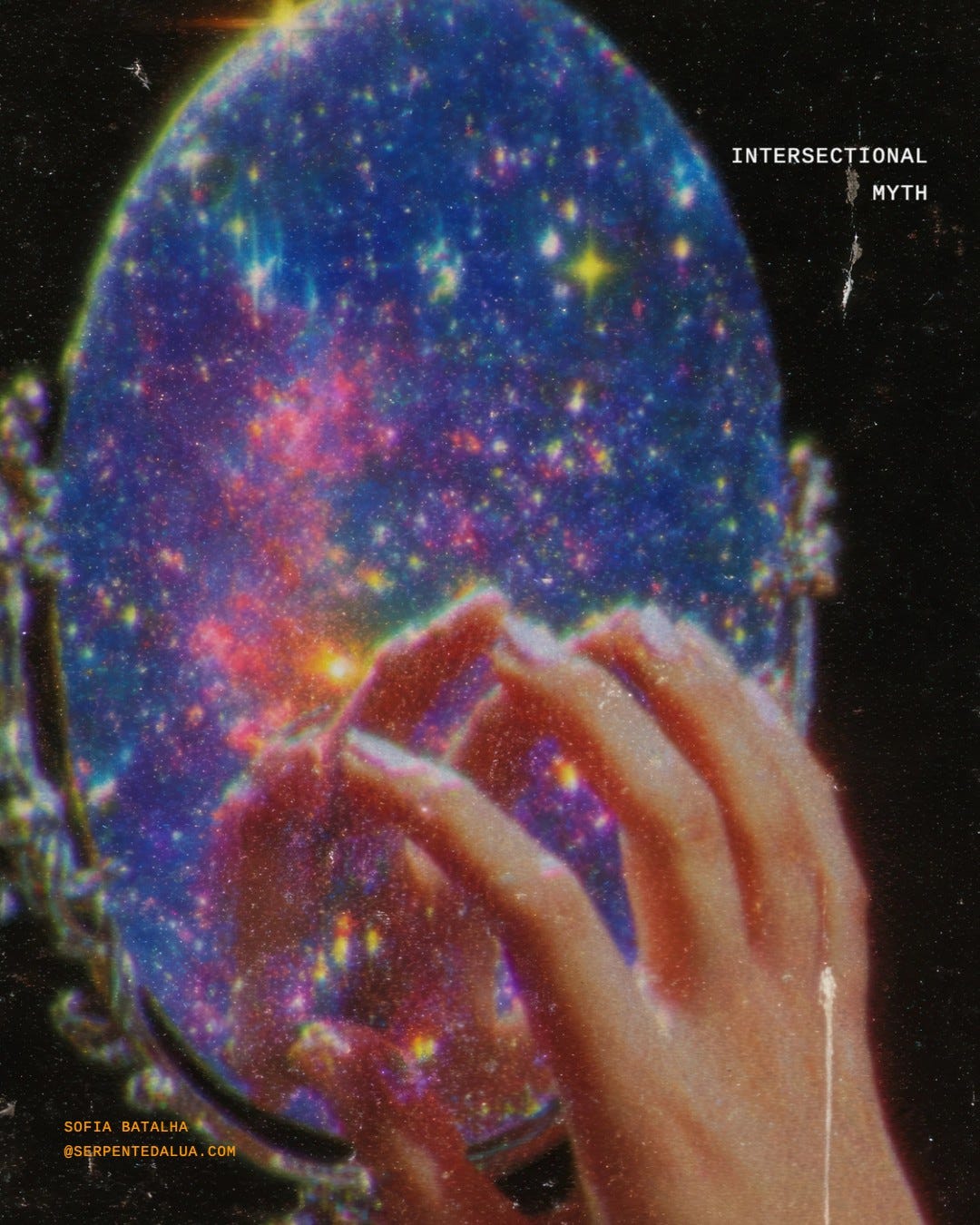
Intersectional Myth
Eco-mythology reveals myth not as a transcendent narrative, but as situated relational infrastructure shaped by ecological, political, economic, (trans)gendered, and non-human entanglements.
If myth is a relational living meshwork, then it cannot help but be intersectional. Not only in the contemporary institutional sense, but also because every myth emerges from inevitable entangled conditions: land, labor, kinship, bodies, food systems, power structures, cosmologies, grief practices, migration routes, class formations, ecologies of survival. From ancestral and future relations.
A myth is never only “spiritual.” It is also agricultural, erotic, economic, political, seasonal, colonial, or anti-colonial, non-human, and ecological. Eco-mythology still remembers that ecology itself is intersectional. Forests were never monocultures, rivers never separate categories, and soil decomposes through relations.
Modern Eurocentric framings often isolate myth into religion, symbolic narrative, literary artifact, or national identity machinery. But older, grassroots mythic fields seem to function more like ecological membranes between forms of life. Myth as a living metabolic bridge between human communities and place. A multiverse of kin.
Once myth is understood this way, intersectionality stops being an “addition” to myth theory and becomes one of its intrinsic conditions.
Because stories about land are also stories about labor, fertility fosters stories about gender; monsters are often stories about social exclusion; borders are stories about empire; gods are stories about governance; purity enables stories about caste/class/race control; apocalypse opens stories about resource anxiety. Even silence inside a myth is political.
But beware because eco-mythology is not “environmental storytelling.” It becomes a pulsating practice of tracing how relational worlds are organized. Not about interpreting symbols, but about the relationships that each myth authorizes, suppresses, eroticizes, normalizes, or renders sacred.
Because there is a difference between living mythic ecologies and ossified mythic infrastructures. A living myth changes with seasonal, communal, and ecological realities. An imperial myth freezes itself into permanence, it wants to be immortal. This is the colonial mythic algorithm. The colonial/nation-state myth often universalizes itself by pretending to transcend context, in one truth, one civilization, one rationality, one progress narrative, one human norm. Above all else, and enforced to all regardless of context.
Whereas grassroots ecological myths tend to remain situated… this river, this drought, this migration, these ancestors, this mountain, this wound, this reciprocity. Not universal abstraction, but situated resonance. And this has profound implications for the intrinsic intersectionality of myth, because, at its deepest level, it is also a refusal of abstraction. You cannot isolate gender from race, race from class, class from geography, geography from ecology, ecology from colonial history, colonial history from epistemology. Likewise, you cannot isolate myth from the material conditions that produce and metabolize it. Every myth is an ecology of power and relation.
I do critique the Eurocentric myth theory, because many canonical Western definitions of myth separate the sacred from material, cosmology from labor, spirit from land, narrative from embodiment. But ecological mythic traditions often refuse those divisions entirely. In these traditions, the sacred is agricultural, the agricultural is political, the political is cosmological, and the cosmological is embodied.
And once those separations collapse, myth becomes less like “belief” and more like a living choreography of relational life.
Let’s also bend the knee to the living ground, for the idea of grassroots myths is vital. Because official myths are usually authored upward by states, empires, priesthoods, and institutions. Whereas ecological myths often emerge from the living metamorphic mesh, through oral repetition, ritual adaptation, communal memory, local ecological attunement, and just everyday survival. This makes them porous, adaptive, and inherently polyvocal. We shatter the ideation of pure systems and open ourselves to evolving relational fields.
The deeper tectonic tension we’re circling is that imperial myth seeks coherence (centralizing, fearing contradiction, and extracting authority and hierarchy from narrative), but ecological myth is entrenched in multiplicity (composts, metabolizes, and generously generates relation through narrative). Personally, this is why eco-mythology becomes politically important now: because ecological collapse is also exposing the exhaustion of the universalizing myths of modernity, brutal ideations of endless growth, separation from nature, human supremacy, linear progress, and extractive individuality. All these are heavily institutionalized myths, imprinted in folk tales and in our bodies.
So let’s not treat myth as a primitive belief, a symbolic artifact, or just nationalist mythology. Let’s remember other processes and possibilities unfolding within its multiverse, such as relational ecology, embodied memory, political topography, sensory attunement, and ongoing kinship between human and non-human worlds.
Join us — “Beyond the Paradox Course”
Gathering a learning community from around the world, this course will help you to embrace the deeper roots of the ecological crisis and explore pathways of healing, from the philosophical and mythological dimensions down to practical tools and actions.
📍 Live on Zoom
🗓 June 9 – July 2
🕔 Tuesdays & Thursdays | 5–7 PM GMT
As an experiment in post-capitalist learning, the course is offered without a paywall. Contribute according to your capacity. No one turned away for lack of funds.
If you’ve been feeling that something essential is missing from mainstream climate conversations… this space may be for you.