
The Swarm Self
Relational Pulsation

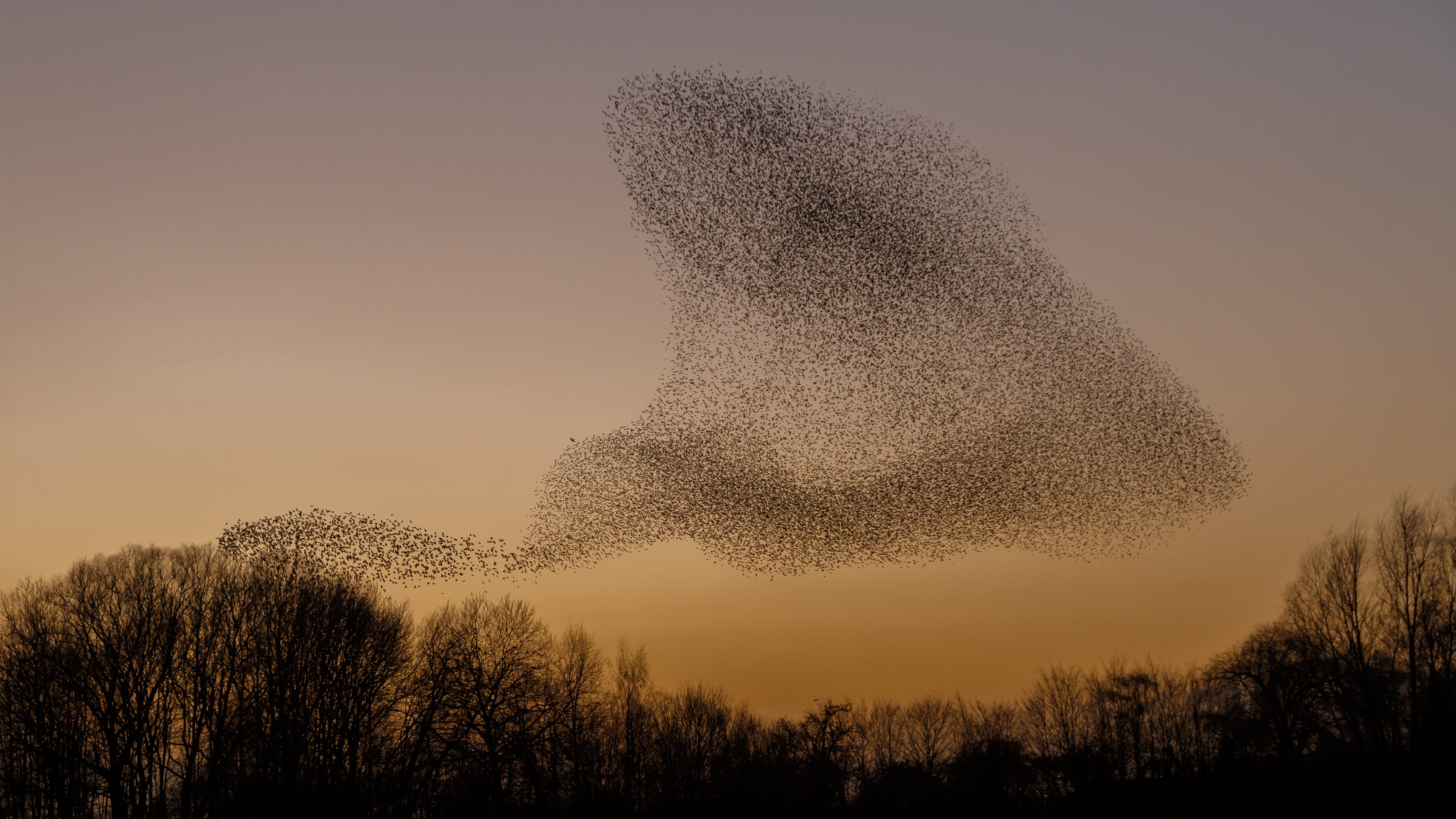
One of the modules of the ecopsychology course I teach is about the “Ecological Self.” But I’ve been brewing, digesting and dreaming, for over a year now, of the idea of the Swarm Self. It’s been unsettling while deeply fecund.
The idea of the “swarm self” was initially forged based on a reading of Joseph Dodds’s book, Psychoanalysis and Ecology at the Edge of Chaos (2011), in which the author explores the concept of “swarm intelligence” at the intersection of complexity theory, psychoanalysis, and the philosophy of Deleuze and Guattari. Interestingly, upon rereading, I was looking for the term in the book, only to realize that I had projected the expression “swarm psyche” onto the text, since this term does not appear in the book—or anywhere else, for that matter. A fertile lapse that ultimately gave rise to a new layer of inquiry and praxis. The Swarm Self proposed along these lines goes beyond the distributed and functional intelligence described by Dodds, as it implies a collective, sensitive, and migratory psychic field, rooted in relational, ecological, and non-modern ontologies.
It is a psyche that moves in swarms, premonitions, oracles, and crossings, closer to the dreaming forest than to the problem-solving algorithm.
This idea is aligned with complexity theory and Deleuze/Guattari, not as a centralized entity, but as a distributed intelligence, where multiple elements (neurons, bodies, symbols, affects, ecologies) co-organize themselves in a continuous process of emergence, contagion, and adaptation. It is a mind in motion, with no fixed subject, no clear origin, and no central command.
*
Although the term “Swarm Self” was a lapse of intuition (maybe of the swarm itself), this is not a new idea. It is an ancestral and future way of sensing the psyche as a collective, migratory, sensitive, and undisciplinable living meshwork. It is the recognition that the psyche is not inside you, but passes through you as a swarm, as a murmur, as a crossing:
It is not internal; it is porous and a passage. The dream is not just yours. The anger is not just yours. Memory is migratory.
Emergent, plural, rhizomatic. The psyche is not organized by fixed structures (id, ego, superego) but by flows, pulsations, and contagions.
Mobile, situated, but not fixed. A flock changes direction without anyone “deciding”; so does the psyche.
Relational, intensive, ecological. There is no separation between psychological feeling and the social, ecological, or spiritual realm.
Chaotic, fertile, untamable. Chaos is not the loss of order, but the cradle of the unprecedented.
Imagine the migration of birds or the flow of a school of fish—direction emerges from the relationship, not from individual leadership. I propose the Swarm Self is trans-subjective, a process, and fundamentally relational, in an I that is not fixed, but entangled, ecological, multicultural, and changeable. A Self that recognizes itself as a knot in a living tapestry, more like a vibrational field than a defined identity. The Swarm Self is like a meshworked ecological cognition, where:
Knowing is not possessing, but resonating with emerging patterns;
Thinking is dancing with affections, signals, instincts, and living territories;
Relationship is metamorphic metabolism, not structure;
And change is not reform, but transmutation, achieved collectively, not by the isolated individual.
{these are our psyches dancing together}
Swarm Self versus Modern Subject
The Swarm Self directly challenges the modern, individual, self-centered, rational, and separated subject. It disrupts the very foundations of modernity, because it is driven by emerging affinity rather than by control.
And this can be unsettling, as the modern impulse is to quickly ask, “Who leads this swarm?”, “What is the purpose?”, “Where is the reason and the goal?”
But the Swarm Self responds with a different logic—one that is rhizomatic and rooted in radical kinship. Perhaps it is not a matter of understanding or mastering this concept, but of sensing when it is happening—in a gathering of birds, in a marching crowd, in an idea that springs up in several minds at once. In experiences in constant flux, spilling beyond boundaries and spreading like contagion, in a collective, wandering, and relational sensibility.
I want to offer the care of the ceremonial mantle that protects and guides those who approach the Swarm Self, with a desire to wear it, because you must first learn to listen, cohabit, and co-respond. It is a living concept, not a step on the ladder of knowledge, it is a collective being that demands care and connection.
The Swarm Self moves as part of a fluid collective, it knows how to be the rhythm of relationships, moves through listening.
I’ve been gathering notes on these ways of experiencing the Self beyond the modern subject, and I even created a questionnaire on the topic. The Swarm Self moves like a murmur, a flock, a school, a thunderstorm, in migration, contagion, and attunement. It is seasonal, contextual, sensitive, deeply kinesthetic, and in affective attunement. But the existential challenge is feeling without a flock and out of rhythm. So the practice is to listen, and then listen some more.
This calls for a collapse of the isolated Self … the modern Self must die so that the Web-like and Ecological Self and the Swarm Self can be born … multiple, embodied, disoriented, and open to the sensible. All this requires tolerance for discomfort, not rushing to fix or silence it. The Swarm Self reveals itself when we allow ourselves to be affected by the tangle, even without knowing where to go. Might it be an antidote to individualistic narcissism, either through belonging to the wounded Earth, and the dissolution into the sentient collective?
We bring the Self home, but to a home that is migratory, alive, seasonal, plural, and respectful of the Earth, of feeling, of ancestral knowledge, and of embodied thought.
If the Web-like and Ecological Self is the Self that recognizes itself as a node in multiple living networks—historical, ecological, symbolic, spiritual. Entangled by everything that touches it, visible and invisible. Deeply connected to the earth, to place, stories, and rhythms. Emerges when you feel the Earth’s grief, listen to the stories that precede you, and recognize your visceral interdependence
The Swarm Self is the Self that emerges from sensitive collective movement. It has no center, but a shifting orientation. It is not stable, but listens to rhythms, attunes itself to the field, and dances with the unexpected. It is a migratory, process-oriented, and inter-affective Self. The Swarm Self emerges when there is confusion, chaos, disorientation—when rational knowledge fails, and the body needs to attune itself to the field, to feel with others before knowing what you feel. Both emerge when we stop trying to be “finished, final individuals.”
When the modern subject crumbles, a multiple, hybrid, seasonal Self emerges.
A Self capable of taking root without hardening, skilled in migrating without forgetting where it comes from. A Self that recognizes itself as body and place, history and rhythm, attunement and wound, offering and longing. It is not a matter of choosing between web or swarm, but of listening to how each layer responds to different contexts with distinct forms of wisdom. It is about recognizing that both coexist, and that every part of us adapts according to the environment, the web, the cycle, the call.

ꉓꂦꌗꂵꀤꉓ-ꉓꃅ꓄ꃅꂦꈤꀤꉓ ꉓꍏꋪ꓄ꂦꁅꋪꍏꉣꃅꀤꍟꌗ
Scream-Prayer . Eco-Mythic Tales . Ecopsychology . Eco-Mythology
(Un)Learning Eco-Mythic Trails
{an invitation to walk together, without a fixed map, with an attentive heart}
Eco-Therapeutic Counseling
{Conversations through the Art of Listening and Silence}
Is this my favorite short piece you’ve written? Possibly! 😊It captures and expands on what The Dragonfly Journey is all about - the “many-eyed whole” that perceives transformative process through relational/vibrational attunement. ❤️