
Unlearning Anesthesia
Shedding the armor to return the “self” to the world.

May there be fruitful paradoxes! This is one of them—quite painful (*), but fruitful…the ambiguity of ecopsychology, which seems “abstract” because it disrupts what modernity has conditioned us to accept as evidence and the only possible truth.
The point is that, for a modern psyche, “reality” means talking about the individual, self-regulation, symptoms, choices, internal narratives, and emotional productivity. But speaking of air, noise, heat, food, territory, water, home, ancestry, coloniality, neighborhood, work, and ecosystem as components of the psyche seems “confusing” because it invites us to shift the very foundation of what counts as psychological.
The armor of resistance is modernity shielding itself from this clash, in a defense against confusion, in which the separate self attempts to preserve its central status in reality.
The isolated individual is an elegant and sophisticated abstraction, naturalized as reality. The body and living places, however—materially concrete, breathing, and inevitably intertwined—have been mutilated, exiled, and forgotten by the psyche. In fact, we call “abstract” that which does not inhabit our bodies, something formless or not reflected in our experience of reality.
*
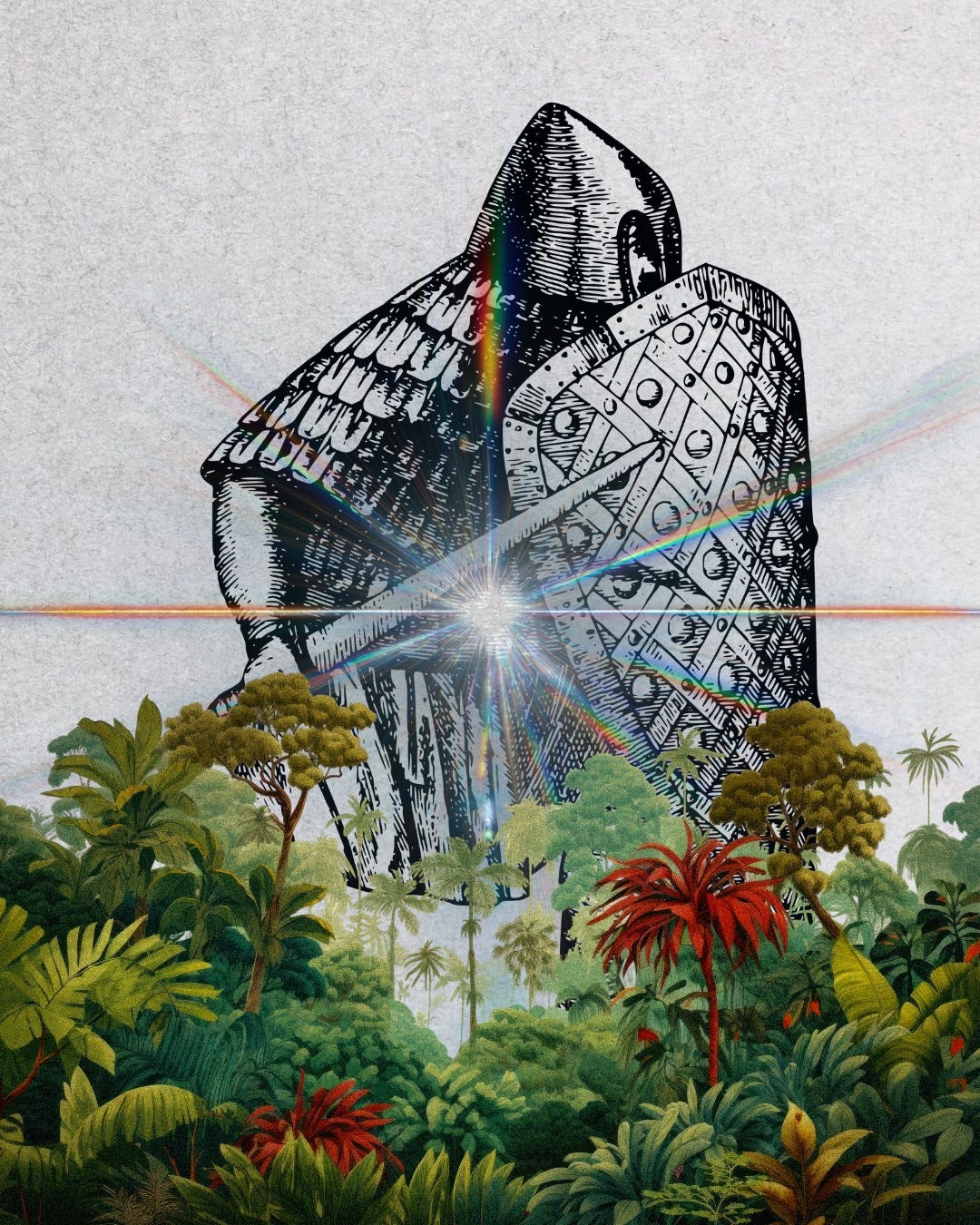
So, before shedding the armor and waking from the anesthesia, the image that comes to mind is that of a “sleeping beauty” wearing an armor, we can distinguish three layers of the challenge as we navigate the meanderings of ecopsychology:
Linguistics: yes, there are new words (old-new worlds, I would say).
Perceptual: because there are relationships that have been unlearned and rendered invisible.
Ontological: there is a “self” that feels it might lose its centrality and has no frame of reference for what this even means.
The third is the deepest and most painful, requiring us to cultivate patience and tenderness. We need warmth and a loving embrace, because the separate self is not transformed by arguments. It can shed its skin, little by little, when it encounters experiences of belonging that are secure enough to prevent it from withdrawing and collapsing out of fear of fusion, fear of disintegration, guilt, or defense mechanisms.
*
Let us now hold onto the question, which may seem like a challenge: what kind of psychology only became possible after separating and removing ecology from the psyche?
Note that we are not trying to replace psychology with ecology; however, we must acknowledge that modernity calls “realist” the most abstract subject it has ever invented—an individual without territory, ancestry, metabolism, ecological debt, dependence… without a world.
Fortunately, and as I often say, I stand on the shoulders of giants—authors, practitioners, and researchers who have raised these questions—which helps me bring references here that name this paradox.
Ahenakew, Stein, Andreotti, and colleagues define separability as a socially imposed and internalized alienation from our place within the Earth’s living metabolism. These authors argue that this is not merely a matter of individualism, but rather a rupture between humans and nature, among humans themselves, between humans and their own selves, and between humans and their responsibilities toward the Earth. They call this an onto-epistemological foundation of the polycrisis and link it to neurocolonization—the domestication and shaping of ways of thinking, feeling, perceiving, relating, desiring, and imagining according to separation, superiority, and subjugation. I’ll add that this is also how we cease to grapple with the real impacts and consequences of our actions.
Now, when we talk about ecology or how our emotions are not just our own, the (modern, priviledged and normopathic) reaction is “this is too abstract,” and although there is also a reaction to the “difficult” vocabulary, what is really happening is that a perceptual defense is being raised, a discomfort is being avoided, or even a “I need more time”. This is legitimate and part of the process of unlearning.
Because what is being asked is not just to understand a new idea, but to temporarily abandon the innocent shelter of the “separate inner self” as the sovereign locus of psychological reality—which is easily confused with reality itself. Ecology becomes “abstract” because it threatens to make everything that modernity taught us to keep out psychological—the city, water, exhaustion, food, colonial history, the climate, noise, the earth, the dead, non-humans, the rhythms of the body. What seems abstract is the attempt to restore body, place, and world to a mind trained to imagine itself without grounding, without a web, and without a place. Devoid of a wider embrace.
Radical ecopsychology has already intuited this when Andy Fisher speaks of the need to “turn the psyche inside out,” for just as the human psyche has exteriority, so too does the nonhuman world possess interiority, agency, depth, and creativity. The task of ecopsychology is not to add “nature” to conventional psychology, but to dismantle the modern dualism that has severed the connection between mind and nature—including the body itself and, above all, culture itself.
Because ecopsychology is not abstract, it makes the concrete—which had been removed from the category of the psyche—visible once again.
*
Returning to the discomfort this causes, we cannot ignore that, for many people, shifting one’s frame of reference is experienced as a loss of stability and even of identity. The words “territory,” “kinship,” “interdependence,” “non-human,” “coloniality,” “place,” “Creation,” “living metabolism” are not merely new concepts, but invitations to shift the center of reality. It is no longer “my inner world” that explains everything, and suffering can no longer be confined solely to individual biography. Now anxiety reveals its connection to precariousness, speed, heat, noise, isolation, extraction, ecological collapse, lack of community, and the loss of the world. This can bring relief, but also a profound sense of vertigo.
Arthur Blume helps us delve deeper into this shift by proposing, drawing on an Indigenous psychology from Turtle Island (present-day United States and Canada), that psychological health does not begin with the individual, but with Creation as a broader community. Creation is always unfolding, emerging, happening. Self-care begins with caring for Creation, for identity, meaning, belonging, and well-being depend on these relationships. He specifically critiques the anthropocentric and hierarchical bias of colonial societies, which prioritize the human and the individual at the expense of the living, relational whole.
So, when the armor of defense is removed, perhaps confusion needs to be honored as a symptom of ontological transition. Confusion, discomfort, and unease may be the moment when the old framework no longer fits, but the new one has not yet taken shape.
The challenge is that the modern psyche tries to resolve this instability by demanding the familiar: “But what does this have to do with me?”, “What’s the practical application?”, “How do I apply this?”, “What technique do I take away from this?”. These are genuine questions, but they can also function as an attempt to tame the journey through the unknown and quickly turn ecology back into a tool for the self.
So, when it seems abstract to you, you can ask: abstract for which part of me? For the mind accustomed to separate concepts? Or for the body that breathes air, eats food, lives in a house, navigates noise, depends on water, feels loneliness, and belongs to a wounded Earth?
There may be a part of us that prefers ecology to remain abstract because, if it becomes intimate, there will be a metamorphosis in how we feel, care, suffer, take responsibility, and belong. And this is far more demanding than “learning concepts,” for when we venture to shed our armor and expose our fragile, porous skin to the world, we also unlearn the anesthesia that keeps us captive.
(*) I should note that this paradox is especially painful in my cultural context, where there are still very few references to other ways of being-world (there are bubbles and collectives that, fortunately, go beyond the norm, of course). This is a hegemonic, colonial, and conservative normative context that avoids, as much as possible, touching on what hurts us all. Generally speaking, those who come to me don’t even have the words—much less the acceptance or points of reference—for the severity of these intertwined crises, and the expectation is “to feel at one with nature.” I bring up this context because it’s important to note that I am addressing a cognitive layer that hasn’t even shed its armor, much less woken from the anesthesia.
ꉓꂦꌗꂵꀤꉓ-ꉓꃅ꓄ꃅꂦꈤꀤꉓ ꉓꍏꋪ꓄ꂦꁅꋪꍏꉣꃅꀤꍟꌗ
Scream-Prayer . Eco-Mythic Tales . Ecopsychology . Eco-Mythology
(Un)Learning Eco-Mythic Trails
{an invitation to walk together, without a fixed map, with an attentive heart}
Eco-Therapeutic Counseling
{Conversations through the Art of Listening and Silence}
References:
Ahenakew, Cash, Sharon Stein, Vanessa Andreotti, Ninawa Inu Huni Kui, Lisa Taylor, Stacey Prince, Jaya Ramesh, Chelsea Williams, Rene Suša, Rose Vukovic, and Claudia Diaz-Diaz. “Decolonizing Mental Health in the Polycrisis: Pathways Toward Neuro-Decolonization.” American Psychologist 80, no. 8 (2025): 1297–1312. https://doi.org/10.1037/amp0001540.
Blume, Arthur W. A New Psychology Based on Community, Equality, and Care of the Earth: An Indigenous American Perspective. Santa Barbara, CA: Praeger, 2020.
Fisher, Andy. Radical Ecopsychology: Psychology in the Service of Life. 2nd ed. Albany: State University of New York Press, 2013.
Fisher, Andy. “What Is Ecopsychology? A Radical View.” In Ecopsychology: Science, Totems, and the Technological Species, edited by Peter H. Kahn Jr. and Patricia H. Hasbach. Cambridge, MA: MIT Press, 2012.