
When plowing a field
A symbolic mechanism for legitimizing violence over land

» (Un)Learning Eco-Mythic Trails
» Eco-Therapeutic Counselling—Conversations through the Art of Listening and Silence
When plowing a field
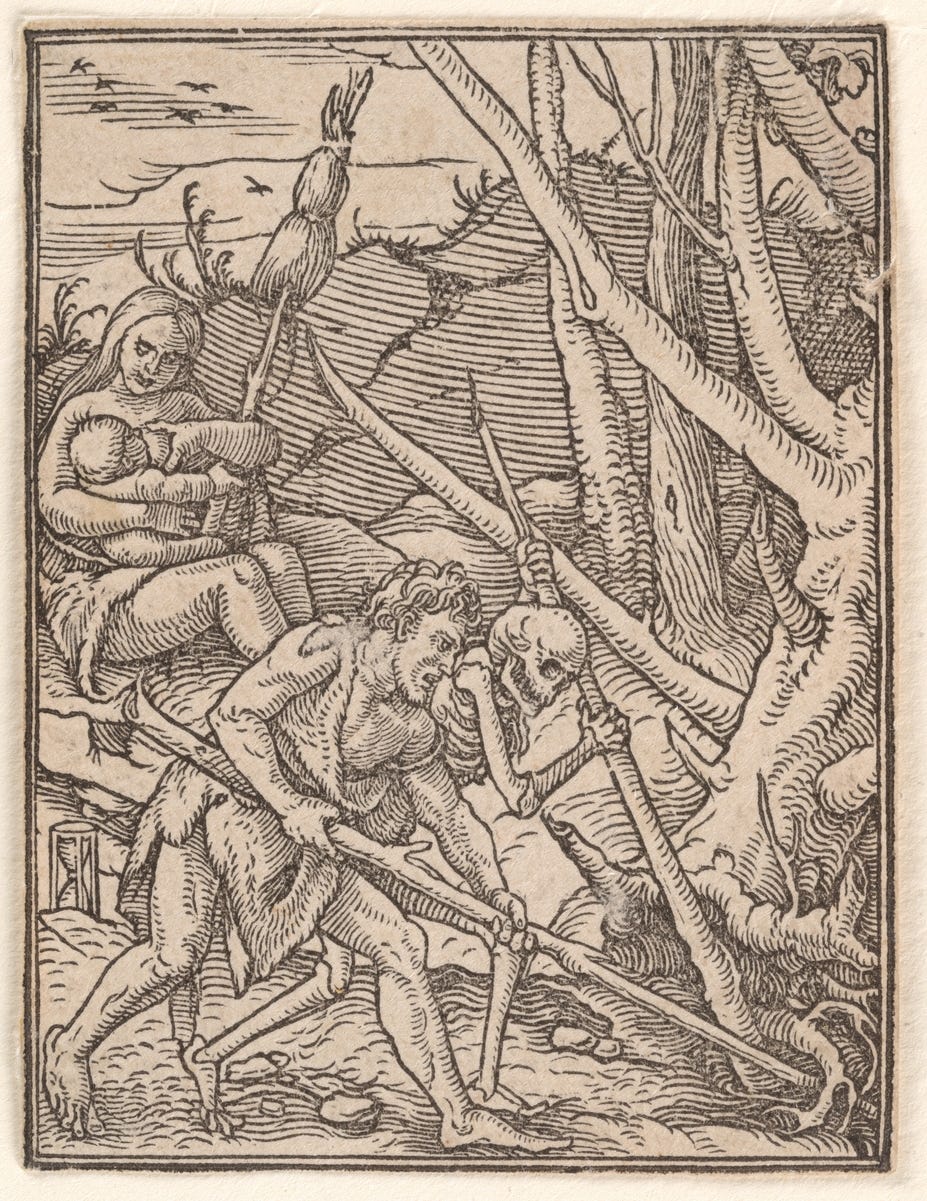
When plowing a field, destroying all its greenery and flowers, it is good to say three times:
“Oh! Fields, you are in mourning, The stars cast a veil; Since your love has died, It is good that heaven cries out.”
Anyone who has read the book The Sanctuary knows that there are many invisible layers in the modern Western psyche that allow devastation to continue in exchange for comfort and convenience. I recently found another one in a traditional Portuguese saying. I was looking for other things when I came across this little saying. I chewed on the pain and disruption it carries, the legitimization of violence. I bring my discomfort with how this little ritual, seemingly one of grief and respect, functions as a symbolic mechanism for legitimizing violence over the earth. A foundation for the implementation of systemic ecocide.
The short verse, said three times when plowing the field after destroying “all its greenery and flowers”, contains a deep tension between recognition and continuity of violence. The ritual gesture does not ignore the loss, on the contrary, it names it. The field is placed in mourning, the stars “cast a veil,” love has died.
There is a clear symbolic awareness that something alive has been interrupted.
However, this recognition does not suspend the action that causes it. The plow continues to tear the earth. Mourning does not interrupt the gesture, it accompanies it.
It is precisely here that the rite reveals its ambivalence. Instead of preventing destruction, it seems to function as a cultural mediation that makes it bearable. Pain is recognized, but immediately framed within a symbolic device that absorbs it. Violence against the field is transformed into an inevitable episode in a moralized cosmos: the sky cries out, the stars mourn, the field suffers—but human labor continues.
The ritual thus operates as a small poetic absolution for the act of devastation.
This mechanism is particularly revealing when placed in dialogue with contemporary critiques of spirituality that seek to transcend pain rather than inhabit it. Many forms of modern spirituality reproduce the impulse to dematerialize suffering and “elevate” pain rather than assume it in its bodily and earthly density, thus escaping the responsibility that emerges from the relationship with the ground. Transcendence becomes escape, a way to evade the ethical implications that arise when we fully recognize what has been destroyed.
The small rural enchantment can therefore be reinterpreted in light of this critique. What appears to be a gesture of respect for the earth also reveals a deeper cultural pattern: the ability to recognize violence without interrupting it. Destruction is ritualized, turned into poetry, and incorporated into a cosmology that makes it acceptable. The language of grief does not generate transformation, nor does it disrupt or cause friction, functioning instead as a moral buffer.
Loss is sung about so that it can continue to happen.
In this sense, the verse reveals something structural in the history of the Western relationship with the land. It is not simply a matter of ignorance or indifference to ecological destruction. Often there is awareness, there is sadness, there are even forms of symbolic reverence. The problem is that this awareness is often absorbed by cultural narratives that accommodate violence rather than interrupting it. The earth is personified, mourned, but remains available to be transformed, captured, extracted, devastated.
Thus, the small ritual can be understood as a precursor to a logic that we now recognize on a planetary scale.
The modern system also produces rituals of mourning—discourses of environmental concern, images of wounded nature, narratives of loss—while continuing to expand the material structures that produce devastation. What we see here, on an intimate and rural scale, is an embryonic form of something that will become systemic: the cultural capacity to symbolically metabolize damage without altering the conditions that generate it.
The problem is not mourning itself. True grief has transformative power, it interrupts, calls for responsibility, and demands change. What this little verse reveals is a domesticated form of grief, a ritual formula that acknowledges loss without allowing it to alter the gesture that produces it. In this process, mourning ceases to be a force for transformation and becomes a cultural device for continuity.
Re-read today, the incantation ceases to be just an ethnographic fragment. It becomes a historical mirror of a deeply ambiguous relationship with the land: a relationship capable of loving, mourning, and destroying simultaneously. It is in this tension—between the awareness of loss and the persistence of violence—that one can glimpse one of the cultural roots of the systemic ecocide that characterizes the present.